
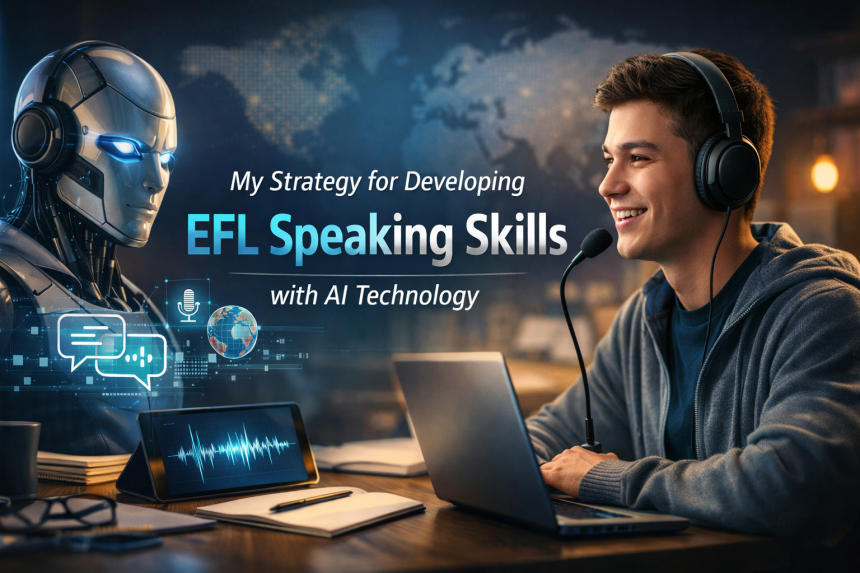
Developing strong speaking skills remains one of toughest challenges for EFL learners. Many students understand grammar, complete reading tasks, score well on written exams, yet hesitate during real conversations. Fear of mistakes, limited vocabulary recall, pronunciation anxiety, lack of real-time feedback create barriers that traditional classrooms often struggle to remove.
My strategy focuses on using AI technology as practical speaking partner, feedback provider, pronunciation coach, confidence builder. Instead of replacing teacher guidance, AI enhances practice frequency, personalization, motivation. Result: measurable fluency growth, stronger self-expression, noticeable confidence improvement.
Why EFL Learners Struggle With Speaking
Before building strategy, understanding problem becomes essential. Common obstacles include:
- Limited exposure to authentic conversation
- Fear of embarrassment
- Slow vocabulary retrieval
- Poor pronunciation clarity
- Lack of personalized correction
- Minimal speaking time during class
Traditional classrooms often allow few minutes per student. Large class size reduces interaction opportunities. Even motivated learners receive limited feedback. AI technology addresses these gaps by providing unlimited practice, instant correction, adaptive conversation.
Core Principles Behind My Strategy
My framework rests on five core principles:
- Consistency over intensity
- Feedback-driven improvement
- Low-pressure speaking environment
- Personalized learning pathways
- Real-world communication focus
AI tools support each principle effectively. Learners practice daily without fear of judgment. Immediate feedback prevents fossilization of errors. Adaptive prompts build confidence gradually.
Step 1: Building Speaking Confidence Through Low-Stress AI Interaction
Confidence forms foundation of speaking fluency. Many EFL learners remain silent due to anxiety rather than lack of knowledge. AI conversation platforms provide safe practice space.
Students begin with structured prompts:
- Introduce yourself
- Describe daily routine
- Explain favorite hobby
- Share opinion about simple topic
AI responds naturally, asks follow-up questions, encourages elaboration. Because no human judgment involved, students experiment more freely. Mistakes become learning opportunities instead of embarrassment triggers.
Early stage goal focuses on speaking without long pauses, not perfection. Fluency before accuracy.
Step 2: Pronunciation Enhancement Using AI Voice Analysis
Clear pronunciation increases intelligibility, boosts confidence. Many learners struggle with specific sounds, word stress, sentence rhythm. AI-powered pronunciation tools analyze speech patterns, highlight mispronounced words, suggest corrections instantly.
My approach includes:
- Daily 10-minute pronunciation drills
- Recording short passages
- Comparing speech with native models
- Practicing minimal pairs
- Focusing on sentence stress patterns
Students receive visual feedback showing sound accuracy percentage. Objective metrics motivate improvement. Gradual clarity development reduces communication breakdown.
Pronunciation practice integrates into routine rather than isolated lesson. Consistency produces visible results within weeks.
Step 3: Vocabulary Activation Through AI-Guided Speaking Tasks
Many learners know vocabulary passively yet fail to use words actively. Strategy emphasizes vocabulary activation.
After introducing new lexical sets, students complete AI conversation tasks requiring usage of target words. For example:
Topic: Environmental issues
Target vocabulary: pollution, sustainability, renewable energy, conservation
AI generates scenario: community meeting discussion. Student explains opinions using required vocabulary naturally. If learner avoids words, AI prompts usage.
Active recall strengthens memory retention. Repetition within contextual dialogue builds automaticity. Vocabulary shifts from passive recognition toward fluent production.
Step 4: Structured Fluency Development Framework
Fluency development requires systematic progression. My structure follows three stages:
Stage 1: Controlled Speaking
- Short responses
- Guided prompts
- Limited grammar complexity
- Focus on smooth delivery
Stage 2: Semi-Controlled Interaction
- Role-play scenarios
- Opinion sharing
- Narrative retelling
- Extended responses
Stage 3: Free Discussion
- Debates
- Problem-solving tasks
- Storytelling
- Professional simulations
AI adapts complexity according to learner performance. Gradual challenge increase prevents overwhelm while encouraging growth.
Step 5: Real-Time Error Correction Without Interrupting Flow
Traditional correction often interrupts conversation. Students lose focus, confidence drops. AI allows delayed correction model.
During conversation, AI records mistakes silently. After discussion ends, feedback appears categorized:
- Grammar errors
- Vocabulary misuse
- Pronunciation issues
- Sentence structure suggestions
Learners review corrections, repeat improved sentences. This maintains communication flow while ensuring accuracy development.
Step 6: Developing Spontaneity Through Timed Speaking Challenges
Spontaneous speaking demands quick thinking. Many EFL learners overthink responses. AI-generated timed tasks improve reaction speed.
Examples include:
- 60-second opinion challenge
- 2-minute storytelling task
- Quick-response interview simulation
- Rapid question rounds
Timer adds mild pressure similar to real conversation. Over time, hesitation decreases. Thought organization improves naturally.
Step 7: Personalized Feedback Reports and Progress Tracking
Data-driven progress tracking strengthens motivation. AI tools generate weekly performance reports including:
- Fluency score
- Pronunciation clarity percentage
- Vocabulary diversity index
- Grammar accuracy rate
- Speaking duration trends
Students visualize improvement graphically. Clear progress encourages consistency. Specific weakness identification guides targeted practice.
Personalized feedback replaces generic comments. Improvement becomes measurable rather than subjective.
Step 8: Integrating AI Into Classroom Environment
AI works best when combined with teacher guidance. My classroom integration model includes:
Pre-Class Preparation
Students complete AI conversation practice before lesson. Topic aligns with upcoming class theme.
In-Class Application
Students participate in pair discussions, group tasks. Confidence gained from AI practice improves participation level.
Post-Class Reflection
Students review AI feedback, correct recurring errors.
This blended model maximizes speaking exposure both inside, outside classroom.
Step 9: Encouraging Critical Thinking Through AI Debates
Advanced learners benefit from debate simulations. AI presents controversial or thought-provoking statements. Student must defend position logically.
Example prompts:
- Remote work benefits outweigh office culture
- Social media impacts mental health positively
- Artificial intelligence improves education quality
Learners construct arguments, provide examples, respond to counterarguments. AI challenges reasoning, asks clarification questions.
This method strengthens both language proficiency, analytical thinking.
Step 10: Building Real-World Communication Skills
Speaking proficiency extends beyond grammar accuracy. Learners require practical communication abilities for travel, study, professional environments.
AI simulations replicate real-life scenarios:
- Job interviews
- Customer service conversations
- Academic presentations
- Business meetings
- Networking events
Students practice formal tone, persuasive language, professional vocabulary. Realistic context enhances relevance, engagement.
Step 11: Developing Self-Correction Habits
Strong speakers monitor own language. AI promotes self-awareness by highlighting repeated mistakes.
Learners maintain error journal including:
- Frequent grammar patterns
- Mispronounced sounds
- Overused vocabulary
- Sentence structure weaknesses
Weekly review encourages conscious correction during future conversations. Gradual independence develops.
Step 12: Increasing Speaking Time Dramatically
Traditional classroom limits speaking opportunities. AI removes time restriction. Students practice anytime: morning, evening, commute breaks.
Daily 15–20 minute AI interaction equals several classroom sessions weekly. Cumulative exposure accelerates fluency growth significantly.
More speaking equals faster improvement. Simple principle, powerful outcome.
Step 13: Motivation Through Gamification Elements
Many AI platforms include progress badges, streak tracking, achievement milestones. Gamification increases engagement.
Students set goals:
- Speak 10 minutes daily
- Reach pronunciation score above 85%
- Complete five debate sessions weekly
Goal-oriented practice enhances discipline, long-term consistency.
Step 14: Addressing Different Proficiency Levels
Strategy adapts according to learner stage:
Beginner Level
- Simple sentence formation
- Basic vocabulary topics
- Slow-paced interaction
- Repetition emphasis
Intermediate Level
- Opinion-based discussion
- Expanded vocabulary tasks
- Role-play scenarios
- Grammar refinement
Advanced Level
- Abstract topics
- Professional simulations
- Complex argumentation
- Nuanced vocabulary usage
Personalization remains key advantage of AI-supported learning.
Step 15: Reducing Fossilized Errors
Long-term learners often develop persistent errors. AI identifies recurring patterns through data tracking.
For example:
- Repeated tense confusion
- Article misuse
- Preposition errors
Targeted micro-lessons address specific weaknesses. Focused repetition eliminates fossilization gradually.
Step 16: Measuring Improvement Objectively
Speaking improvement often feels subjective. AI analytics provide objective benchmarks:
- Words per minute
- Pause frequency
- Lexical diversity
- Grammar precision percentage
Objective data builds trust in learning process. Students observe tangible growth rather than relying on vague impressions.
Step 17: Encouraging Reflective Learning
After each AI session, learners answer reflection questions:
- What went well?
- Which words felt difficult?
- Where did hesitation occur?
- Which corrections surprised you?
Reflection deepens awareness, accelerates improvement cycle.
Step 18: Creating Habit-Based Learning Routine
Sustainable progress requires routine. My recommended weekly structure:
- Monday: Pronunciation drills + short conversation
- Tuesday: Vocabulary-focused dialogue
- Wednesday: Timed fluency challenge
- Thursday: Debate simulation
- Friday: Real-world scenario practice
- Weekend: Review feedback + reflection
Consistent structure prevents randomness. Habit formation strengthens discipline.
Step 19: Addressing Common Concerns About AI Use
Some educators worry about overreliance on technology. My approach positions AI as supplement, not replacement.
Teacher role remains essential for:
- Emotional encouragement
- Cultural nuance explanation
- Complex grammar clarification
- Personalized mentorship
AI handles repetitive practice, immediate feedback, data tracking. Balanced integration ensures optimal results.
Step 20: Long-Term Impact on Learner Confidence
After several months using AI-supported strategy, noticeable transformations occur:
- Students speak longer without hesitation.
- Pronunciation becomes clearer.
- Vocabulary usage expands naturally.
- Anxiety reduces significantly.
- Participation during class increases dramatically.
Confidence grows from repeated success experiences. Practice without fear gradually removes psychological barriers.
Practical Results Observed
Through implementation of this strategy, learners demonstrate:
- Faster response time
- Improved coherence
- Better sentence structuring
- Greater lexical range
- Stronger argument development
- Higher speaking test scores
Most importantly, willingness to communicate increases. Communication becomes enjoyable rather than stressful.
Frequently Asked Question
How does AI improve EFL speaking skills?
AI provides unlimited speaking practice, instant feedback, pronunciation analysis, personalized conversation simulations.
Can AI replace an English teacher?
No. AI supports practice and feedback, while teachers provide guidance, emotional support, cultural context, deeper instruction.
How often should students practice speaking with AI?
Daily practice of 15–20 minutes produces noticeable fluency improvement within weeks.
Does AI help with pronunciation accuracy?
Yes. Voice recognition technology analyzes sounds, stress patterns, intonation, then suggests specific corrections.
Is AI suitable for beginners?
Yes. AI adapts difficulty level, provides simple prompts, gradual progression based on learner ability.
How does AI reduce speaking anxiety?
Private, judgment-free interaction creates safe environment for experimentation, mistake correction, confidence building.
What measurable results can students expect?
Improved fluency speed, clearer pronunciation, expanded vocabulary usage, stronger confidence during real conversations.
Conclusion
Developing EFL speaking skills demands consistent practice, meaningful feedback, supportive environment. AI technology offers scalable, personalized solution addressing traditional classroom limitations. My strategy combines structured progression, pronunciation training, vocabulary activation, fluency challenges, real-world simulations, reflective learning.