
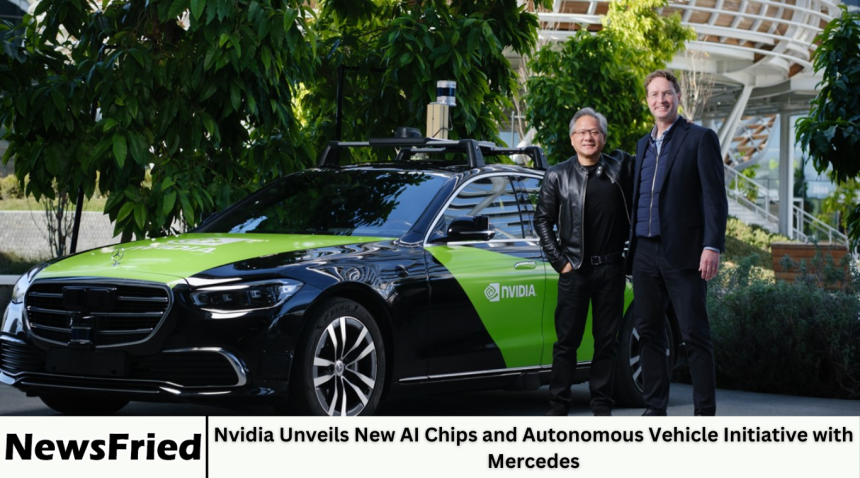
In 2026, Nvidia unveiled major advances in artificial intelligence chips and autonomous vehicle systems. These announcements mark a bold expansion of Nvidia’s strategy beyond data centers and AI software into the future of transportation. At the heart of this vision is a new generation of AI chips designed to run powerful autonomous driving systems, and a deep collaboration with Mercedes‑Benz to bring AI‑driven vehicles to real roads.
At major industry events, Nvidia CEO Jensen Huang outlined the company’s plans to deliver next-generation computing platforms, software stacks, and partnerships that enable vehicles to see, reason, and drive safely with minimal human intervention. The initiative promises significant progress toward commercially viable autonomous mobility — from intelligent driver assistance to fully robotaxi-capable systems.
New AI Chips Powering Tomorrow’s Mobility
Nvidia announced a new generation of AI-optimized chips designed to accelerate intelligent computing, including autonomous driving workloads. These chips integrate powerful GPU and CPU cores, high-bandwidth memory, and advanced networking — enabling faster processing of the massive data streams generated by autonomous vehicles and other AI applications.
The chip designs emphasize energy efficiency and scalability, ensuring that both data centers and vehicle systems can run complex neural networks effectively. This is crucial because autonomous vehicles must process camera feeds, radar inputs, lidar signals, and other sensor data in real time — a demanding task that benefits directly from high-performance AI silicon.
These advanced chips aim to support a range of AI workloads, from deep learning to simulation environments and multimodal reasoning, making them foundational for Nvidia’s autonomous driving ecosystem.
The DRIVE AV Software Stack
Hardware alone is not enough for safe autonomy. Nvidia also unveiled key software advancements through its DRIVE AV software stack. This full-stack autonomous driving framework combines perception, planning, and reasoning algorithms that enable vehicles to understand their environment and make real-time decisions.
DRIVE AV goes beyond traditional rule-based automation by using AI models that can evaluate complex driving scenarios — including unpredictable pedestrian movement, unusual road conditions, or crowded urban traffic — to choose the safest possible actions. This level of sophistication requires extensive AI training, simulation, and validation before it can be deployed on real roads.
The software is designed to be automotive-grade, undergoing rigorous safety testing and combined with redundancy systems so that critical functions remain reliable even in edge cases.
Collaboration With Mercedes‑Benz
A central part of Nvidia’s autonomous vehicle initiative is its collaboration with Mercedes‑Benz, one of the world’s most respected automotive manufacturers. Nvidia and Mercedes‑Benz have been working together for several years to integrate artificial intelligence into next-generation vehicles.
In 2026, this collaboration reached new heights when Nvidia’s DRIVE AV software and advanced chips began appearing in production vehicles. The first result of the partnership is the Mercedes‑Benz CLA equipped with Nvidia’s DRIVE AV driver assistance software, enabling advanced Level 2 automated capabilities. This system helps with steering, braking, acceleration, lane keeping, and other driving tasks, with the goal of improving safety and driver comfort.
Building on this foundation, Nvidia and Mercedes‑Benz have also announced collaborations to bring more advanced autonomous functionalities to future vehicles. Subsequent models, including future S-Class variants, will incorporate DRIVE AV with architecture designed to support Level 4 autonomy, meaning vehicles could operate without human supervision in specific conditions.
How These Systems Work Together
The Nvidia-Mercedes driving initiative combines several layers of technology:
- AI Chips: High-performance cores that process neural networks for perception, decision-making, and control.
- Sensor Fusion: Inputs from cameras, radar, lidar, and ultrasonic sensors are merged and interpreted to build a real-time understanding of the vehicle’s environment.
- AI Software Stack: DRIVE AV and related AI models running on the chips translate perception into action.
- Safety Architectures: Redundant systems and safety-tested code ensure the vehicle behaves reliably.
Together, these systems enable vehicles to perceive their surroundings, evaluate options safely, and execute accurate driving decisions — core requirements for autonomous mobility.
Expanding Industry Partnerships
While Mercedes‑Benz is one marquee partner, Nvidia’s autonomous ecosystem extends further. Multiple automakers and mobility service providers are working with Nvidia’s DRIVE architecture to accelerate Level 4 readiness for robotaxis and autonomous fleets.
This broad industry alignment means the same underlying compute platform, software stack, and simulation tools can be used by multiple manufacturers. That helps scale development, reduce integration costs, and accelerate deployment of safe autonomous solutions.
Partnerships also include joint AI data programs where real-world driving data and simulation data are combined to train and refine models — a key requirement for improving autonomy in diverse environments.
Real‑World Impact: Safety and Innovation
Integrating AI into vehicles has immediate benefits:
Safety is a major priority. Nvidia’s autonomous driving software and hardware are designed to prevent accidents by analyzing real-time data faster and more comprehensively than a human driver can. Automated systems can anticipate hazards and react quickly to sudden changes in traffic conditions.
Comfort and convenience are also improved. Advanced driver assistance reduces mental and physical fatigue, particularly in highway driving. Future autonomous features could support hands-off driving in controlled environments.
Innovation across industries is another benefit. AI-powered mobility systems can contribute to logistics, ride-hailing services, and new transportation models that reduce congestion and emissions.
Challenges and Considerations
Despite rapid progress, autonomous vehicle technology still faces challenges:
- Regulation and Standards: Governments must update policies to allow higher levels of autonomy safely.
- Public Trust: Drivers must be confident that autonomous systems are reliable in all conditions.
- Technical Complexity: Advanced AI systems require rigorous testing to handle rare or unpredictable scenarios.
- Infrastructure: Roads, mapping data, and vehicle-to-infrastructure communication need ongoing development.
These challenges require cooperation among automakers, regulators, technology providers, and communities to ensure safe deployment.
Looking Ahead
Nvidia’s announcements in 2026 are early milestones in a longer journey toward fully autonomous vehicles. As chip performance increases and AI models continue to improve, autonomous driving systems will become more capable and widespread.
Fully self-driving robotaxis could launch in major cities as early as 2027, and private vehicles with advanced autonomy may follow soon after. In the meantime, partnerships like the one with Mercedes‑Benz demonstrate how AI technology can enhance safety and performance in everyday driving today.
Frequently Asked Questions
What new AI chips did Nvidia unveil?
Nvidia revealed next-generation AI computing platforms designed to handle large-scale AI workloads, including advanced autonomous driving systems that improve performance, efficiency, and real-time data processing.
How is Nvidia working with Mercedes‑Benz?
Nvidia and Mercedes‑Benz are collaborating to integrate Nvidia’s DRIVE AV software and AI compute platforms into vehicles, starting with advanced driver assistance systems and moving toward future autonomous capabilities.
What is Nvidia DRIVE AV?
NVIDIA DRIVE AV is a full software stack that enables vehicles to perceive their environment, plan safe actions, and operate autonomously using advanced AI models and sensor data.
When could autonomous cars powered by Nvidia technology arrive?
Certain advanced assisted driving features are already appearing in 2026 vehicles, and more advanced autonomous systems — including Level 4 robotaxis — could roll out in selected markets by 2027.
Are these technologies safe?
Automakers and Nvidia emphasize safety with rigorous testing, redundant systems, and real-world validation, but regulatory approvals and continued development are necessary before full autonomy is widespread.
Conclusion
Nvidia’s unveiling of new AI chips and its autonomous vehicle initiative with Mercedes‑Benz represents a major step forward in the evolution of intelligent transportation. By combining powerful silicon, advanced AI software, and strategic industry partnerships, Nvidia is pushing the boundaries of what vehicles can do — from enhanced driver assistance to fully autonomous driving in the near future.