
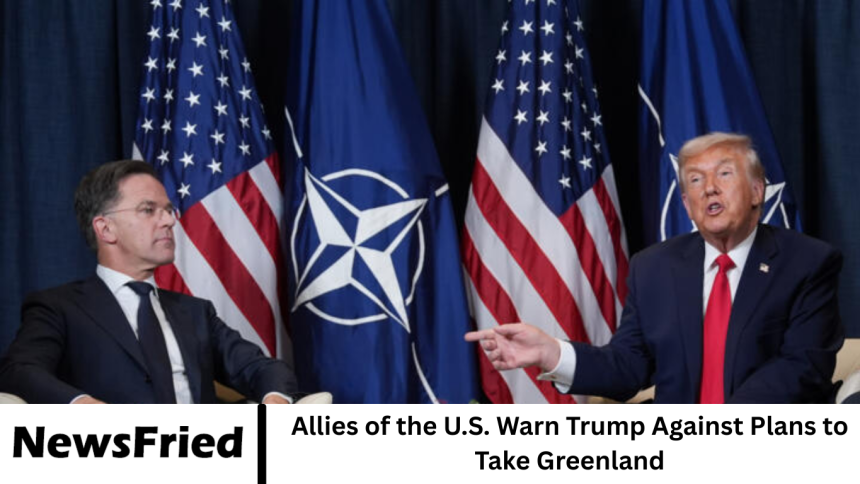
The idea of purchasing or seizing foreign territory may sound like a relic of centuries past, yet it resurfaced in modern geopolitical discourse when Donald Trump expressed interest in acquiring Greenland. What began as a seemingly unconventional proposal quickly escalated into a global diplomatic concern, drawing sharp reactions from U.S. allies across Europe and beyond.
The topic “Allies of the U.S. Warn Trump Against Plans to Take Greenland” reflects a complex intersection of diplomacy, international law, Arctic strategy, and global power dynamics. Greenland, an autonomous territory within the Kingdom of Denmark, is not just a remote island covered in ice—it is a strategic asset rich in natural resources and geopolitical significance.
Understanding Greenland’s Strategic Importance
Geographic and Political Significance
Greenland is the world’s largest island, located between the Arctic and Atlantic Oceans. Despite its vast size, it has a small population but enormous strategic importance.
- It sits along critical Arctic shipping routes
- It hosts valuable natural resources like rare earth minerals
- It plays a key role in climate monitoring
- It is central to Arctic military positioning
Greenland is part of the Kingdom of Denmark but enjoys a high degree of autonomy, managing its own domestic affairs while Denmark handles defense and foreign policy.
More Read: Breakthrough Blood Tests May Offer Life-Saving Early Detection of Alzheimer’s Disease
The Arctic: A New Geopolitical Frontier
As climate change melts Arctic ice, new shipping routes and access to untapped resources are emerging. This has intensified competition among global powers such as the United States, Russia, and China.
Greenland’s location makes it a strategic hub for:
- Military surveillance
- Missile defense systems
- Resource extraction
- Trade routes
This explains why the U.S. has maintained a presence at Thule Air Base, highlighting its long-standing interest in the region.
Trump’s Greenland Proposal: What Happened?
The Initial Suggestion
In 2019, reports surfaced that Donald Trump had discussed the possibility of buying Greenland from Denmark. While the idea was initially met with disbelief, it soon became a serious diplomatic issue.
Trump described the idea as a “large real estate deal,” emphasizing its strategic and economic potential.
Global Reaction
The response from Denmark was swift and firm. Danish officials rejected the proposal outright, stating that Greenland was not for sale.
The Prime Minister of Denmark at the time, Mette Frederiksen, called the idea “absurd,” which led to a diplomatic rift between the two nations.
Trump responded by canceling a planned visit to Denmark, further escalating tensions.
Allies of the U.S. Warn Trump Against Plans to Take Greenland
European Concerns
European allies viewed the proposal as:
- A violation of sovereignty
- A destabilizing geopolitical move
- A throwback to colonial-era thinking
Countries within the European Union expressed concern that such actions could undermine international norms and alliances.
NATO Implications
Greenland’s strategic importance also ties into NATO’s defense framework. Any attempt to acquire or control Greenland outside diplomatic norms could disrupt alliance unity.
NATO members worried that:
- It could weaken trust among allies
- It might embolden rival powers
- It could create internal divisions
Diplomatic Fallout
The controversy strained U.S.-Denmark relations and raised broader concerns among allies about U.S. foreign policy direction during Trump’s presidency.
Legal and Ethical Issues
Can a Country Be Bought?
While the U.S. has historically purchased land—such as the Louisiana Purchase and Alaska—modern international law makes such transactions far more complex.
Key legal concerns include:
- The right to self-determination
- Sovereignty of nations
- Consent of the local population
Greenland’s people have the right to decide their own future, making any external acquisition highly unlikely without their approval.
International Law and Sovereignty
The United Nations Charter emphasizes respect for territorial integrity. Any attempt to acquire land without proper consent could be seen as a violation of international law.
Why Greenland Matters to the United States
Military Interests
The U.S. already operates Thule Air Base in Greenland, which is crucial for:
- Missile warning systems
- Space surveillance
- Arctic defense
Control over Greenland could enhance U.S. military capabilities in the Arctic.
Economic Opportunities
Greenland is rich in:
- Rare earth minerals
- Oil and gas reserves
- Fisheries
These resources are increasingly valuable in a world driven by technology and energy demands.
Countering Global Rivals
The U.S. is particularly concerned about the growing influence of China and Russia in the Arctic.
Acquiring or strengthening ties with Greenland could help counter these rivals.
Denmark and Greenland’s Response
Firm Rejection
Denmark made it clear that Greenland is not for sale. The government emphasized:
- Respect for sovereignty
- Commitment to international norms
- Support for Greenland’s autonomy
Greenland’s Perspective
Greenland’s leaders also rejected the idea, highlighting their desire for greater independence rather than foreign control.
The people of Greenland view themselves as a distinct community with their own identity and aspirations.
Historical Context of Territorial Purchases
Past U.S. Acquisitions
The United States has previously expanded its territory through purchases, including:
- Louisiana (from France)
- Alaska (from Russia)
These deals were conducted under very different historical conditions.
Why It’s Different Today
Modern geopolitics emphasizes:
- National sovereignty
- Democratic governance
- International cooperation
This makes territorial purchases far more controversial and complex.
Geopolitical Risks of the Proposal
Strained Alliances
The proposal risked damaging relationships with key allies, particularly in Europe.
Encouraging Rival Powers
Such actions could set a precedent that encourages other countries to pursue similar strategies.
Undermining Global Norms
The idea of acquiring territory in the 21st century challenges established international norms.
Media and Public Reaction
Global Criticism
Media outlets worldwide criticized the proposal as unrealistic and outdated.
Public Opinion
Public reactions ranged from amusement to concern, with many questioning the seriousness of the idea.
Long-Term mplications
Arctic Competition
The incident highlighted the growing importance of the Arctic in global politics.
U.S. Foreign Policy
It raised questions about the direction and consistency of U.S. foreign policy.
Allied Trust
Maintaining trust among allies remains a critical challenge for the United States.
Frequently Asked Question
Why did Trump want to buy Greenland?
Trump saw Greenland as a strategic asset with military, economic, and geopolitical value.
Who owns Greenland?
Greenland is an autonomous territory within the Kingdom of Denmark.
Can the U.S. legally buy Greenland?
It would require approval from Denmark and the people of Greenland, making it highly unlikely.
Why did U.S. allies oppose the idea?
They viewed it as a violation of sovereignty and a threat to international norms.
What makes Greenland strategically important?
Its location, natural resources, and role in Arctic geopolitics make it highly valuable.
How did Denmark respond to the proposal?
Denmark firmly rejected it, stating that Greenland is not for sale.
Is the U.S. still interested in Greenland?
While the purchase idea faded, the U.S. remains interested in Greenland for strategic reasons.
Conclusion
The controversy surrounding “Allies of the U.S. Warn Trump Against Plans to Take Greenland” serves as a powerful reminder of the complexities of modern geopolitics. While the idea of acquiring Greenland may have been rooted in strategic considerations, it clashed with contemporary values of sovereignty, international law, and diplomatic cooperation.